

A financial advisor’s reflection on stocks for the long run
In 1982, during my third year at UMass and as a member of the investment club, the Dow Jones Industrial Average moved above 1,000. It had reached that level a decade earlier but failed to hold it, and many of us believed it would not last. The 1970s had conditioned investors to expect little from stocks.
By the end of July 1985, when I became an advisor, the Dow sat at 1,347.45. Today it sits at approximately 52,000—roughly 40 times higher.
The path was far from smooth. Between those points came the 1987 crash, the dot-com bust, the 2008 financial crisis, and the 2020 COVID collapse. Each brought significant stock market declines; each was eventually followed by a stock market recovery.
The chart below illustrates the long-term difference between stocks, cash, and inflation. From August 1976 through August 2026:
- U.S. inflation is up 6X.
- 3-month U.S. Treasury bills, traditionally considered a relatively safe place for cash, are up 8X.
- The S&P 500 total return index is up 283X.
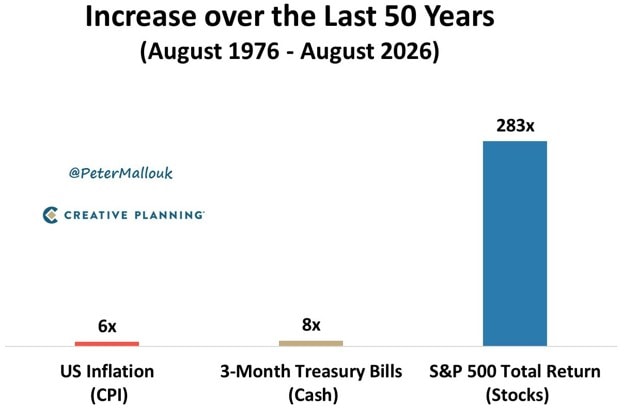
Over that half century, cash barely outpaced inflation, while $1 invested in the S&P 500 total return index grew to $283. Those gains came not from successfully predicting each market move, but from staying invested long enough for compounding to work.
That principle is simple, but not easy. Stocks have historically been higher one year later about 75% of the time, which also means investors have experienced declines roughly one year in four. Those periods test investors as headlines intensify, account values decline, and the urge to react grows.
A key part of my role as a financial advisor is helping clients stay focused on their long-term goals during those periods—not by predicting the market’s next move, but by keeping the purpose and time horizon of their money in view. A retirement that is fifteen years away is not defined by one difficult quarter but rather a thoughtful plan, clear goals, and the discipline to stay the course.
In 1982, I doubted the Dow could hold 1,000. In 1985, I could not have imagined 52,000.
Four decades have reinforced a simple lesson for me: successful long-term investing requires patience. We cannot know what comes next, but history gives us a compelling reason to keep the long view.